



AI voice agents can answer questions, route calls, and handle routine requests. But when a customer needs a person, automation has to make room for a human conversation. If the right representative is helping someone else, there is still a wait. That’s why hold music still matters in the age of AI agents.
Contact centers still need a thoughtful plan for what callers hear between asking for help and receiving it. Music on hold and useful messages on hold belong in that plan, especially when callers arrive frustrated by an automated interaction.
Customers still want access to a person
On November 1, 2026, The Times reported on Trustpilot research showing that just 4% of British consumers wanted businesses to make greater use of AI in customer service, down from 10% the previous year. Meanwhile, 55% said being able to speak to a person rather than a chatbot was important, up from 51%.
Gartner research published in August 2026 adds an instructive detail. In a survey of 3,566 business and consumer customers, 50% said generative AI made service interactions easier. Yet 87% considered an option to reach a human agent essential when companies use that technology.
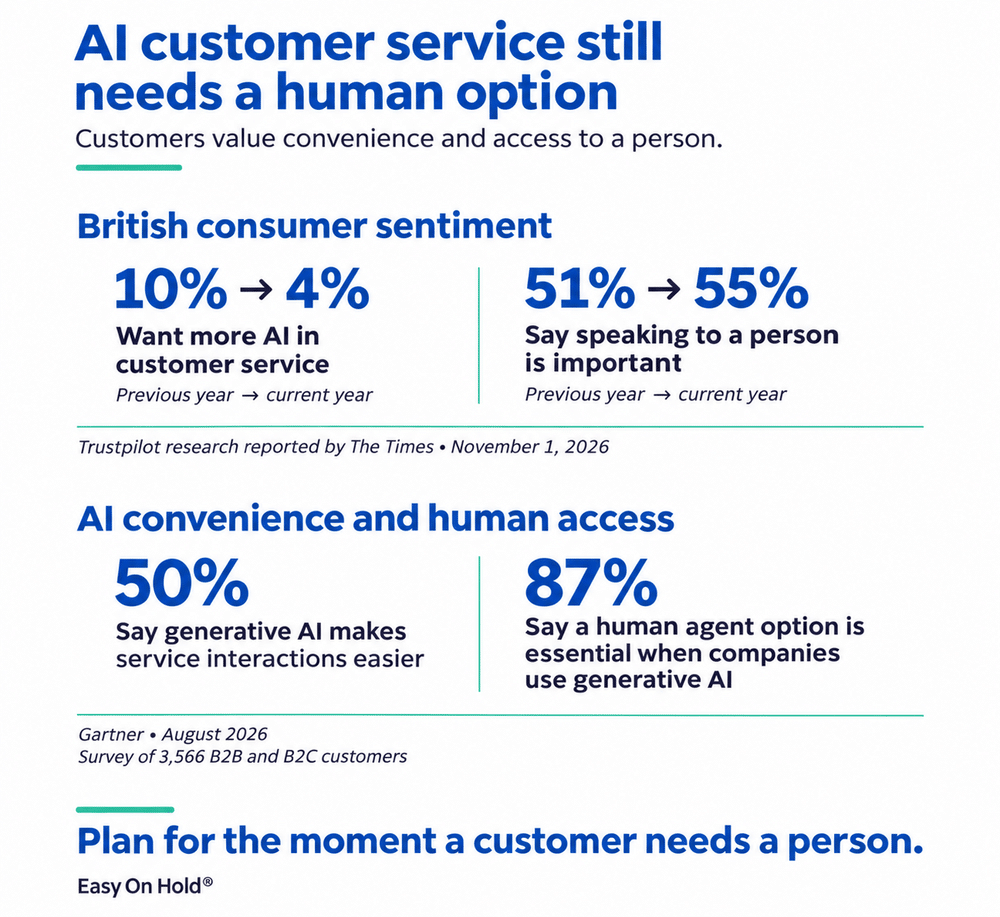
Those findings can coexist. Customers can appreciate an automated solution and still want a person available when it falls short. A successful AI interaction does not make human customer service obsolete. It makes automation useful for that particular task.
Getting past the AI agent has become part of the customer journey
A Fox News column offering tips for bypassing customer service bots illustrates the desire to reach a person.
For contact center leaders, the lesson is less about any particular workaround and more about the effort customers feel they must make. Someone who has begun searching for ways around a service system is trying to regain control of the interaction.
Consider a caller disputing a bill. The automated agent may explain the policy correctly, but the caller needs someone authorized to examine an exception. Repeating the policy does not move that request forward. Neither does asking the same question in different words.
At that point, a clear offer to connect with a representative can be more helpful than another conversational turn. The caller may prefer a reasonable, clearly explained wait to continuing an exchange that is going nowhere. That is a practical possibility, not evidence that customers enjoy being on hold.
AI handoffs need human oversight
The problem can become harder to untangle when multiple automated systems handle the same issue.
In an account published by Martechify, an AI vendor described a test deployment involving a homeowner and two different AI systems. The systems supplied conflicting technician arrival information after an earlier automated interaction. The homeowner ultimately contacted a human dispatcher.
This reported example illustrates a risk rather than establishing how frequently it occurs. Passing an interaction between systems does not guarantee that the information passed along is accurate.
For a call center, the operational question is straightforward: when information conflicts, who can check the underlying record and take responsibility for the answer? A human escalation path should be part of the service design, with the conversation history available so the customer does not have to start over.
An immediate AI response does not always mean immediate service
There is a difference between answering a call and determining its reason.
A conversational AI agent can respond immediately while the customer remains no closer to a decision, correction, or appointment. If the system cannot complete the task and makes human assistance difficult to reach, the interaction can feel like a delay tactic, regardless of the company’s intention.
We explored that distinction in The Death of Hold Music: Big News or Big Hype?. Reducing unnecessary waiting is a worthwhile goal. Declaring hold music obsolete does not address the situations in which callers still need an available employee.
Once a caller needs a human, contact centers must manage the transition. That includes explaining what happens next and planning the audio heard while waiting.
Music on hold and messages on hold still have a job to do
A queue remains part of the customer experience, even after an AI interaction. In fact, that moment deserves particular attention: the caller may already have spent time explaining a problem without getting it resolved.
Music on hold provides an audible background while the caller waits. Messages on hold can supply context, practical information, and preparation for the conversation ahead. Neither should be used to justify avoidable delays.
A thoughtful program should:
- Explain the next step accurately, including whether the caller is waiting for a representative.
- Give useful preparation, such as which reference number or documents to have ready.
- Include brief information relevant to the department or reason for calling.
- Balance spoken messages with suitable music so callers are not subjected to continuous announcements.
- Remove expired information and avoid repeating the same short message too frequently.
The wording matters. A caller who has just struggled with a chatbot may find repeated instructions to use that same chatbot particularly unhelpful. A generic sales pitch may also be poorly timed for someone trying to resolve a service failure.
The content should reflect the caller’s position in the service process.
Useful information can make hold time more worthwhile
Messages on hold can do more than repeat a company’s name or ask for patience. They can provide information that has value beyond the call.
For example, AccuWeather® On Hold from Easy On Hold® delivers professionally voiced, ZIP-code-specific weather announcements updated hourly. It offers a way to include timely local information alongside music and business messages.
A local forecast may be especially relevant for callers planning a visit, traveling to an appointment, or arranging outdoor work. Its usefulness depends on the audience. A geographically dispersed support queue may need a different content approach from a local equipment dealership.
The same editorial judgment applies to business music in a physical location: consider who is listening, why they are there, and what fits the setting. On the phone, that judgment also needs to account for the caller’s immediate service needs.
AI voice can help improve the on hold experience
AI voice technology also has a role in producing the information callers hear. A business can use AI-generated narration to prepare announcements and update messages as circumstances change.
That is a different job from asking an AI agent to conduct an open-ended customer service conversation. A prepared announcement can be reviewed for accuracy, pronunciation, and tone before it reaches callers.
Contact centers can use AI to support their teams while continuing to invest in human service and the waiting experience. These decisions belong together. Adding automation at the beginning of a call does not remove responsibility for everything that follows.
Plan for the caller who still needs a human
When evaluating AI agents, call centers should test the entire resolution path. Can a caller request a person? Does the handoff preserve context? What happens when information is uncertain? What does the caller hear if no representative is immediately available?
Track outcomes alongside automation rates: whether issues were resolved, whether customers called again, and whether people abandoned the queue after escalation. A shorter automated interaction is valuable when it helps the customer get the right result.
Hold music is not going away simply because an AI agent answers first. As long as customers need human help and employees cannot always answer immediately, the waiting experience needs attention.
For the caller who has finally reached the path to a person, that wait can represent progress. Contact centers should support it with clear expectations, appropriate music, and information worth hearing.
Explore Music On Hold Services from Easy On Hold® and build a waiting experience that fits the people calling your business.